Sunday, November 23, 2014
This Week I Learned...
Monday, April 14, 2014
Leadership Thoughts from 'Draft Day'
- Leaders take responsibility. When he announces to the team that they have the #1 overall pick, Costner acknowledges that they have not scouted the QB as well as they should have. "That's my fault, that's on me. But we're going to get it done now." He settles the issue and moves to address it. Similarly, he pulls aside his cap analyst and apologizes for not having the right reaction to her pregnancy. "I'm sorry I didn't get all excited and start talking about what color we were going to paint the baby room. I didn't respond the way you needed me to and I was wrong". He doesn't try to pin the blame on her, or explain it away. He acknowledges his failures, and then moves to correct them.
- Leaders are not door mats. While he is quick to accept blame for his own failures, he does not give everyone else a free pass. When Cleveland's current QB trashes his office, frustrated by the apparent snub of being replaced, Costner does not apologize or try to be understanding, but puts him in his place. On Draft Day, the GM's responsibility is to acquire the best players for the team, not mentor and manage current members. When Costner finds his scouts looking at pictures of the QB in the Draft with his girlfriends instead of doing research he does not apologize for the culture he has created or for not providing oversight. "I am working very hard to not loose my shit on all of your right now, and you are making it extremely difficult." Leaders carry much of the responsibility, but they should not try to carry the responsibility born by their subordinates.
- Good leaders know when to push their subordinates and when to let them work. Cleveland's owner can be debated, but I believe he made two decisions that helped Costner succeed. First, he impressed on him the importance of making a 'splash' in the draft, and then toward the end of the film, he shuts up when Costner tells him "give me five minutes and then if you don't like what I've done you can fire me." Sometimes the boss has to be the fire that gets his people moving. Without his involvement, Costner would have drafted the MLB at the 7th pick, instead of getting two great 1st round players. The owner never anticipated what Costner would do, but he provided the impetuous for Costner to be great.
- Good leaders know how to gauge intangibles. A lot of people said that Costner 'went with his gut' when decided not to draft the top QB. But he didn't. He found ways to gauge the things few other people looked at.
- He evaluated response to failure. By watching how the QB reacted to getting sacked, he saw someone without guts, who got rattled easily when things broke down and someone who focused on not getting hit over executing the plan.
- He evaluated honesty. By looking at how the QB responded to the 100 dollar bill test and how the answered tough questions, he saw someone more concerned with appearances than dealing with reality.
- He evaluated people skills. By looking at how the QB worked with his team mates, Costner saw someone who had red flags among the people who knew him best.
Monday, March 17, 2014
Intentions and Decisions
Thursday, November 14, 2013
"Left of the Boom"
The solution, General McCrystal said, was to "get ahead of the boom", stop the IEDs before they were detonated. Thus they instituted regular patrols, sniper teams conducting over watch, and other measures that prevented the IEDs from being deployed in the first place.
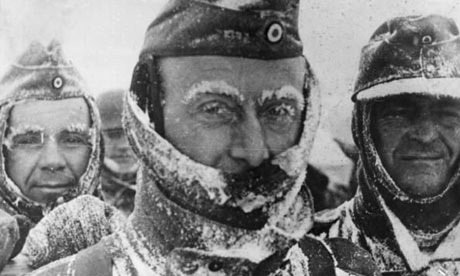
This is a large and important part of a leader's job. Great leaders must be able to look forward and identify incoming problems and stop them before they happen. This happens at two levels. First, executive leaders are positioned to see the big picture and make substantial changes thereto. In our example, Operation Barbarossa, the freezing cold of the Russian winter represents the 'boom'. German high command knew about the cold, but believed they could make ti to Moscow and defeat the Russian military before the cold effected them too much. Not only did they fail to set realistic goals, they had no contingency plans for if those goals failed. When those two are combined they are fatal. Getting left of the boom for them would have meant either, a) equipping their men and equipment to operate in the cold or b) developing a plan to fall back to prepared positions if the Russian forces remained unbeaten by a certain point.
However, while executive level leaders have the ability to influence the big picture, they often overlook details, or occasionally miss the big picture entirely., which is where mid to lower level leaders come in. It is their responsibility to make the big picture as described by the executive leader happen as best they can ad pass up bits of information or warnings when appropriate. Thus, while mid level leaders must have a general understanding of the big picture, their focus must be on the areas under their control. Lower levels of an organization are often tempted to waste time and energy complaining about the ineptitude of their commanders. While such complaints may often be valid, and valuable in their place, they are often unproductive. The German infantry officer who sent a few messages up the chain and then proceeded to train his men to deal with cold weather would ultimately have more impact than the officer who spent most of his energy complaining to or about higher.
So, take time to get above the crush and grind of now, the things immediately important. A little time each week looking ahead will go a long way to getting left of the boom for you and yours. Even if you are not at the top, getting you and your people out of trouble, even if it isn't as neat and tidy as if higher had done it, will still make a difference, which is what being a leader is all about.
image from The Guardian at http://www.theguardian.com/world/2009/sep/06/operation-barbarossa-russia-second-world-war
Tuesday, November 12, 2013
Wiley's "Boots Off the Ground"
- Drones: They have proven themselves reliable and effective on a wide range of missions. However, in several instances they can cause collateral damage in civilian casualties, which may turn out to make them counterproductive in the long run.
- Cyber Warefare: Bloodless, high tech, and apparently clean, everyone thinks they are very cool. it has a very high potential to be turned back around on us. In 2010 the program Olympic Games malfunctioned and America's cutting edge offensive cyber weapon was broadcast all over the world for everyone to look at and pick apart. Also, leaks in the cyber age dwarf leaks in the Cold War era where files had to be photocopied one page at a time. Now someone can carry out on a flash drive or post on the internet millions of files full of sensitive information.
- Special Forces. Very effective and precise, America boasts the best overall Special Forces in the world. However, a contributing factor in their success has been a technological gap between them and their targets that is rapidly shrinking. In addition, special forces are primarily useful to remove negative forces opposing our national strategy. They have limited usefulness in nation building or projecting positive influence that our policies may call for.
Tuesday, August 6, 2013
Civil Forfeiture & Personal Responsibility
"The basic principle behind asset forfeiture is appealing. It enables authorities to confiscate cash or property obtained through illicit means, and, in many states, funnel the proceeds directly into the fight against crime...In general, you needn't be found guilty to have your assets claimed by law enforcement; in some states, suspicion on a par with “probable cause” is sufficient. Nor must you be charged with a crime, or even be accused of one. Unlike criminal forfeiture, which requires that a person be convicted of an offense before his or her property is confiscated, civil forfeiture amounts to a lawsuit filed directly against a possession, regardless of its owner’s guilt or innocence."
The practice began with the prosecution of pirates and smugglers, where it was easier to prosecute the ship you had instead of the captain who was somewhere on the ocean thousands of miles away. The practice was used later to help fund anti-drug operations, then expanded further with the Comprehensive Crime Control Act in 1984 which allowed a large percentage of the confiscated funds to be returned to local law enforcement by the federal government. This helps get funds out of the hands of drug cartels which are currently lopping heads off on the U.S.-Mexico border, and into the hands of underfunded law enforcement agencies.
The problem arises with incidents like those recorded in Stillman's article, when local police use the law to fleece law abiding citizens. Officers will target rental and out of state vehicles, stop them for minor or made up offences like speeding or driving too close to the white line. Once stopped, they offer the driver two options, be charged incarcerated and charged, or sign over their valuables to the city. In one instance two parents were told their child would be taken away and placed in a foster home if they did not sign over their cash. I encourage you to take the time to read the article, it lays out a very interesting view of our law enforcement that it is our responsibility to hold accountable.
This is the reason that a government of limited powers operated by virtuous citizens is a good idea. What we have in Civil Forfeiture is a piece of legislation, like many passed by our government, that has great potential to do good. Many of us would agree that confiscating drug money and funding local law enforcement with that money isn't a bad idea. However, the law's potential to be abused is just as great if not greater. Few of us would agree that innocent people being harassed in this manner is a good thing.
The knee jerk reaction that many of us have is that there needs to be a new law, a new oversight committee, some government action that will solve the problem. But all the laws in the world will not stop humans from behaving like humans. The IRS has oversight committees, the NSA has oversight committees, and every citizen sits on the presidential oversight committee. Yet in the last few months we have discovered that the IRS has been discriminating in a horrific manner based on organization's political leanings, the NSA has been performing unprecedented surveillance on our own citizens, and Benghazi continues to be at best a grisly monument to the stupidity of our government or at worst an act of treason.
We have long looked to the government as the solution to our problems, and are now discovering like the ancient Greeks that the ruler's power to do good is equal to its power to do evil.
Sunday, July 21, 2013
Humanities in Crisis
Thursday, April 11, 2013
Don't Stop, Don't Drop.
For those of you who are not in the Corps, the Guidon is the unit flag which represents the standards, the history, and the goals of the unit, not unlike the Eagle of the Roman Legions. The guidon bearer is chosen each year in a process know as Guidon Candidacy, a two-three week period in which freshmen carry mock guidons during increased physical training and take part in a variety of leadership development and stress evaluation exercises. When I was a fish, the most daunting part of Guidon training was the high port runs, in which we carried our flags over our heads for 2-4 mile runs. As we fell out for our first high port run, the current Guidon bearer formed us up and said "I have one piece of advice for you when it comes to high porting, don't stop, and don't drop."
That piece of advice has gotten me a long way over the last few years. Don't stop trying, working, or giving and don't drop your standards, your morals, or yourself.
In the article, the author talks about the atmosphere that her cross country coach created, in part by talking about what made them different from the rest of the school. We do this a lot in the Corps, and it is apart of creating excellence in whatever organization we are apart of. This exclusiveness, this concept of us being separate and somehow better than them fosters a healthy pride in the organization and a drive to live up to the high standards that form our identity as separate from theirs. In the Corps, one of the forms this takes is attendance at Silver Taps and Echo Taps, where we remember and pay homage to the memory of Aggies and Cadets who have passed away. We pride ourselves on attending these events in mass because these ceremonies separate us from those who are not Aggies, those who are not Cadets.
This all by itself creates merely pride and snobbery. But there is a difference between the pride of a Marine and the pride of, say, a career politician. The second believe he has risen above the rest, is wiser and better than everyone else and is thus entitled to whatever its politicians are entitled to. The first, in contrast, knows that he has been trained beyond what most others have, knows that he is stronger and tougher than most others, but he knows also that that all the training and preparation has taken place so that he can serve others.
The author of the article talks a lot about helping others and focusing on what we can do for them. My junior year in the Corps one of my jobs was to conduct physical training tests for several units. The final event of the test was a mile and half timed run. At nearly every single test, the leaders of the outfit would come sailing in well under the time limit, wait for a few seconds to catch their breath, turn around and run back onto the track, reappearing a few minutes later running in with the slower fish who struggled to meet the time limit. They did not stand at the finish line beating their chests or bragging about their speed, they quietly used their gifts to motivate and encourage others.
That is why we must push ourselves, why we must work to develop ourselves and those around us, so that we may give back to others.
"Let him that stole steal no more: but rather let him labour, working withhis hands the thing which is good, that he may have to give to him that needeth." Ephesians 4:28
Note: After my sophomore year, highporting was banned in the Corps and cadets are no longer allowed to conduct highport runs.
Friday, April 5, 2013
Do. Your. Job.
Do your job.
It seems simple, but I and others have wasted vast amounts of time and energy doing anything but. In the Corps, as in just about any organization, there is always something going wrong, something to worry, argue, complain, or debate about. There are always people who could be doing their job better, and there are always things that need to be done better. On the other side, there are always personal goals that we all have, either to do community service, grow in our relationship with God, or develop friendships with those around us. The problem that arises is when we neglect to fulfill our responsibilities and chase instead after other things, whether relationships or personal pleasures.
Too often we worry about the people who are not taking care of their responsibilities, and spend valuable time and energy complaining or gossiping about people who are not doing their job, time and energy that could be better spent completing our assigned tasks and leading those around us. Very often, if you perform your job well, you can cover for the mistakes or failures of others and you can set a good example for your subordinates and peers, which will in turn elevate their performance. People who do their job well consistently for long periods of time can build amazing amounts of influence and credibility. It does not happen overnight, but if day in and day out you show up and give 100% of your effort to do your job and then to help others, you will be able to have a positive impact beyond what you imagine.
I've often heard my dad talk about those Christians who are "so heavenly minded that they are no earthly good", and in the Corps I've seen people like this a lot. The Christians who had the most impact for Christ were not the ones who went to all the bible studies, were at church every Sunday or made every christian retreat, but the ones who did their jobs well. I don't mean to belittle these things, they are very healthy and important for good christian growth. However, I have seen time and again young Christians come back from a bible study or retreat all excited and trying to minister to their roommate or buddies, only to get the cold shoulder. They wonder why their buddies don't respond more positively, and the answer is that while they were off 'getting into the word' and 'fellow-shipping with their brothers and sisters in Christ' their buddies were cleaning up the mess they left behind, scrambling to rewrite the training schedule that was left unfinished or unapproved, or giving the briefing that the christian skipped out on. Bible studies are important, no less than Church, retreats, mission trips, and all the rest, but if we are going to be good witness for Christ, we have to begin by taking care of our responsibilities to others.
It is easy at the end of the day to look at what you did and give yourself a pat on the back for being better than everyone else. You worked hard and they didn't. But remember a few things.
First, everyone has their own struggles and hardships. When you are picking up slack for someone else, remember that people have been picking up your slack since before you were born. Even aside from what our parents do for us, everyone has bad days, problems, and weaknesses. While today you are covering for someone else, someday you will need someone to cover for you.
Second, its not about you. At the end of the day what matters is if freshmen learned the drill movements, if the shipment got out the door, if the reports got filed, if the job got done. When we learn to be humble and handle our own load, we might have the opportunity to help someone else and achieve things bigger than ourselves.
Monday, July 30, 2012
Why We Need Health Care (Part II)
In this post I will look at why liberals look to the government as the solution of the problem. We identified their assumption that the reason for an excess of wealth in one area is a lack of it in another. They believe that there is a finite amount of wealth, which means those who have more than average have stolen it from those who have less.
Having determined that there is theft going on, (from one income bracket to another) the liberal then looks to see who or what has the power to remedy the situation. The most obvious candidate is government, it has the power to compel people to do its bidding, and the wealthy will not surrender the amount of income required of him willingly.
Thus, the liberal sees government as the best force with the right to equalize the wealth of a nation, because the nation is not capable of doing it itself. When big business steals from the poor or otherwise takes advantage of them, the poor have no one to turn to except government. Thus the government become the ultimate charity, collecting from the wealthy to care for the poor. The collections take the form of taxes, and the government uses those taxes to pay for doctors, food stamps, medication, etc. In this way, the wealthy CEO of Walmart pays a portion of his earnings back into the system, allowing it to be used to help and provide for people in the lower income brackets he makes his money off of.
This is why people like Marx or Hitler look to some form of populist government and force to achieve what they see as social justice. Because people with wealth have been shaped by the capitalistic culture that surrounds them, they are motivated by greed and self interest and thus are more concerned about themselves than the community and must be forced to share and take care of the community.
Government becomes the ultimate parent, making sure the children share and get along while also providing just what every child needs.
Monday, July 16, 2012
Why We Need Health Care (Part I)
We begin with a basic problem, there is a vast disparity in wealth among Americans. While some have golden toilets, others have difficulty paying for their plumbing from month to month. While some charter private jets to fly from city to city, others cannot afford a car to drive to work. A portion of our society cannot afford the basics of life in modern America. This raises two questions.
- Why are people deprived or lacking in basic necessities and comforts?
- How do we go about fixing the problem.
Saturday, July 7, 2012
Health Care
- Whoever has the gold, makes the rules. We laugh about it, but it is true, the people who pay for something decide how to handle it, and since FDR's New Deal we have relied more and more on the government to take care of our social issues. When the government is responsible for all those things and we demand that the government pay for our education, our doctors, our medicine, and our house, and sometimes our food, then we should not be surprised when they tell us that we have to buy health insurance. I don't think they should make us buy health insurance, but I also don't think the government should pay for everything else either.
- The Supreme Court is not meant to bite the bullet and clean up the mess that our representatives make. We can rail on Chief Justice Roberts all we want but it was the representatives we elected who did not stop the Health Care bill, and that is what we pay them to do. The Supreme Court is already a highly politicized institution, anyone who watched the confirmation hearings for Justices Roberts, Alito, or Kagan remember how nasty they were. A lot of that was based around their opinions on Roe v. Wade, which supercharged the court and has become a litmus test for appointments on both sides. Also, it might help to remember the court packing plan of FDR. The Supreme Court blocked much of what FDR proposed, and in response, the president planned to rearrange much of the Judicial branch to remove the opposition to his proposals and announced it to the nation in one of his fireside chats. This was avoided when several Justices retired or switched positions on the Supreme Court and thus made it unnecessary, but the threat was very real, and it is possible that Chief Justice Roberts was afraid of beginning a war with the executive or legislative branches that could severely hurt the Court and the nation.
- If you don't like what congress is doing, then do your job. It is our duty as citizens to make informed decisions on election day. Election day is coming up, get informed. its that simple.
A friend of mine, William Schwennson wrote an excellent article on the recent EU summit and the Supreme Court ruling. He has read the 193 page Supreme Court opinion and has some good insights into what it means. You can find it here.
On a final note, please keep the family of Lt. Col. Roy Lin Tisdale in your prayers. He left a wife and several children including a young son. However bad things seem to be going for us, it helps to remember "At least we aren't being shot at".
Semper Fi.
Monday, June 18, 2012
Learning
When I went into my freshman year of College, I thought a lot of things that appear silly now. I have learned a lot from the last few years, and one of them is that the government will not fix our problems. It matters very little whether Ron Paul, Mitt Romney, or President Obama is in the White House, and it matters less who controls congress. What matters is us.
For those of us who are Christians, we are called to live out the commands of Christ, to let his light shine through us. We will produce far deeper and more lasting good on this world if we simply shine the light of God onto the people around us. If we consistently love one another as Christ loved us we will have an impact that the social conservatives have only imagined.
Look at a few of the big social issues the Church is concerned with: abortion, marriage, and welfare. If every christian young man lived responsibly, kept his word, honored the women around him as Paul commanded, and was generous to help the people he knew, those three issues would shrink overnight. The Church needs to clean its own house before it can send people out to clean up the culture.
I am far from perfect, as my buddies in the Corps can tell you, and I have failed many times to uphold the commands of Christ in everyday life. When we are faced with failure in our immediate lives, it is easier to blame the fall of society on Congress or on the courts, as I well know. As Christ said, we must remove the log from our own eye before we can remove the spec from our brother's.
Saturday, February 11, 2012
Iranian Mess
As is usually the case, the situation is a lot more complicated than it would appear at first glance and will take time and energy to solve, and more than a little sacrifice on everyone's part.
Tuesday, August 16, 2011
Politics: Ready, Set...Lie
"If this guy prints more money between now and the election, I don't know what y'all would do to him in Iowa, but we would treat him pretty ugly down in Texas," Perry said in Cedar Rapids, Iowa. "I mean, printing more money to play politics at this particular time in American history is almost ... treasonous in my opinion." "
In Reality: Fair enough, Perry probably shouldn't have said it, but keep in mind that democrats have been vilifying tea-party republicans (who proposed Cut-Cap-and-Balance, the ONLY plan proposed by congress that S&P admitted would have prevented the downgrade, and also the ONLY plan the president and democratic leaders refused to discuss) as 'terrorists' and 'hostage takers'. So fair enough, Perry should refrain from suggesting physical violence, but nothing out of the ordinary.
2. Working for Al Gore's Campaign
In the Article:"Already, he was questioned Monday about his post as Al Gore's Texas campaign chairman during Gore's unsuccessful 1988 bid for president. Perry claimed these were the days before Gore was "Mr. Global Warming," but Politico.com noted that Gore was talking about global warming before his 1988 bid. "
In Reality: Read the above. 'Perry claimed these were the days before Gore was "Mr. Global Warming"'. So what if Gore mentioned Global Warming a few times. He didn't go off the deep end until after Bush beat him in the 2000 elections. Perry is right, Politico.com is being stupid.
"Just two years ago, the governor of Texas openly talked about leading Texas out of the United States of America -- and now this campaign has caused him to profess his love for the United States. I think it's a remarkable turnaround," Gibbs said."
In Reality: To be fair to Fox, most of this comes from Gibbs, though they failed to contradict the blatant lie Gibbs told. Perry never said he would lead Texas in Secession. What he said was that if England continued ignoring what the colonies want then there might be problems...sorry, got mixed up there. He said that if Washington 'continues to thumb their noses at the american people, who knows what may come of it.' Thumbing noses may refer to pushing the healthcare bill through in secret sessions, confiscating copies of the proposed bill from voters wanting to speak with their congress men, denying voters access to their congressmen, lying about what was in the bill, etc, all of which was being done by the political establishment in Washington when Perry made the above remarks. If Perry was in any way wrong, then we might as well throw out the Declaration of Independence. Mr. Gibbs is wrong in that Perry didn't talk about leading any kind of Secession (he indicated that if anything happened it would be ordinary people fed up with Washington, not politicians), and that it wasn't Texas Seceding, it was American citizens from every state.Sunday, July 31, 2011
A Republic, A Tyranny
Friday, July 29, 2011
Default, Aaaahh! Not.
Joker One
Sunday, July 24, 2011
Government: The Problem For All Our Solutions.
- Neither House Democrats nor President Obama have presented a plan. They have critiqued various parts of the Republican plan, but have not presented a plan themselves.
- The spending cuts that Democrats in Congress, and President Obama, are willing to allow are far in the future, while the tax increases they are demanding take effect far sooner. Also, in the past when democrats have made deals with Republicans such as "one dollar in tax increases for three dollars in spending cuts", the tax increases have taken place and congress never actually gets around to making the cuts. This is what happened to Ronald Reagan and George H. W. Bush.
- Republicans think that the way out of the recession is to allow more money to stay in the private sector, increasing business capital to allow more job creation. Democrats on the other hand think that the economy can be jump started by the government spending large amounts of borrowed money in incentives and programs.
- Republicans worry that if we simply raise the debt ceiling, then U.S. debt will be downgraded in value as people loose faith that it will ever be repaid. Everyone will be paid by money borrowed from somebody else until eventually nobody else will lend, leaving the last group of lenders will not get paid, and nobody wants to be the second to last group that doesn't get paid.